
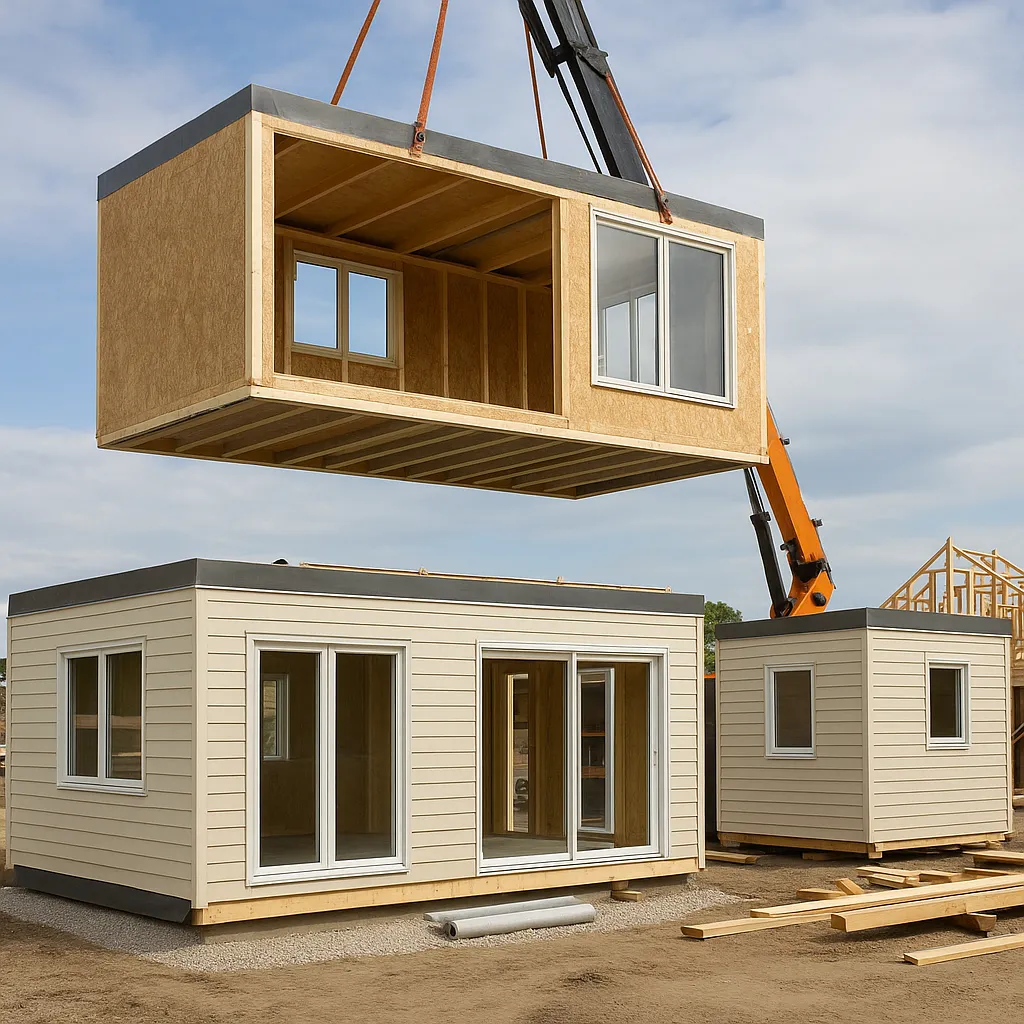
Modular homes compress construction time, improve quality control, and lower lifecycle costs by shifting most work into a controlled factory environment. Here is a practical, end-to-end guide—from concept to keys.
What Exactly Is a Modular Home?
A modular home is built from volumetric units—three-dimensional modules fabricated in a factory with structure, insulation, windows, doors, services, and interior finishes installed before shipment. On site, modules are craned onto prepared foundations, mechanically joined, weather-sealed, and connected to utilities. The result is a permanent building that meets the same codes as site-built homes, but with far greater predictability and speed.
While “modular” can be confused with “panelized,” the difference is scope: panels are flat elements assembled on site; modules arrive as near-complete rooms or sections, which dramatically shortens on-site programs and reduces weather risk.
Stage 1 — Brief, Feasibility, and Design
Every successful modular project starts with a clear brief: site constraints, target floor area, aesthetic direction, energy goals, budget, and timeline. The design team then develops a layout that aligns with the manufacturer’s module grid (for example, standard widths that fit transport rules). Early coordination avoids expensive later changes and unlocks efficiencies like repeated wet-room “pods,” stacked services, and simplified structural spans.
- Planning & codes: Confirm local zoning, height limits, setbacks, and energy requirements. Modular homes are permanent buildings and must comply fully.
- Performance targets: Define airtightness, U-values, sound insulation, and fire ratings at concept stage.
- Design freeze: Freeze interfaces (structure, MEP, facade) before factory release to prevent cascading rework.
Stage 2 — Engineering, Prototyping, and Approvals
With layouts agreed, structural and building-services engineers translate the concept into manufacturable modules. Digital models (BIM) drive clash detection and CNC output for framing, cut lists, and joinery. Manufacturers often build a prototype corner or a complete module for verification—checking tolerances, airtightness details, and assembly time.
Approvals include building permits, foundation design sign-off, and any third-party certifications (fire tests, acoustic reports, CE/EN conformity). A thorough submittal package—specifications, shop drawings, method statements—reduces inspection friction later.
Stage 3 — Factory Production
Factory production proceeds along a controlled assembly line with checkpoints:
- Framing & structure: Timber, steel, or hybrid frames are jig-built to millimeter accuracy. Sheathing adds racking strength; service cavities are planned to avoid penetrations through the airtight layer.
- Envelope & windows: Insulation, membranes, tapes, and triple-glazed units are installed indoors, achieving consistent thermal and airtight performance.
- MEP integration: Electrical wiring, plumbing, ventilation ducting, and heating/cooling equipment are pre-installed and pressure-tested.
- Finishes: Drywall, tiling, paint, cabinetry, flooring, and sanitaryware are completed under clean, dry conditions—limiting defects and dust.
- Quality assurance: Every module passes checklists (dimensions, moisture levels, insulation continuity, electrical testing). Issues are corrected immediately on the line.
Parallel to factory production, the site team constructs foundations and utility stubs. This concurrency is a key time-saver: when modules are ready, the site is ready.
Stage 4 — Logistics and Transport
Transport planning begins early to optimize module size for road permits and ferry routes. Modules are wrapped and weather-protected, with lifting points certified for crane operations. A detailed delivery schedule aligns trucks with crane windows, avoiding idle time and neighborhood disruption.
- Route surveys: Check bridge heights, turning radii, and weight limits.
- Staging & sequencing: Load modules in the order they will be set, reducing double handling.
- Weather contingencies: Reserve backup crane slots and have temporary covers ready for unexpected rain or wind.
Stage 5 — On-Site Assembly and Structural Stitching
Installation typically spans days, not weeks. The crane sets modules on the foundation, where surveyors confirm level and alignment. Crews bolt units together, seal joints, and connect MEP risers. External cladding interfaces and roof junctions are weather-tightened immediately to protect interiors.
After “box set,” the team completes roof finishes, facade details, balconies, and site-built elements such as porches or garages. Interior stitch lines—where modules meet—are taped, plastered, and painted for a seamless look.
Stage 6 — Services, Commissioning, and Handover
Commissioning verifies that systems deliver the performance promised:
- MEP testing: Pressure tests for plumbing, electrical checks, ventilation balancing, and heat-pump commissioning.
- Airtightness test: Blower-door results confirm envelope quality and reveal any leaks for remediation.
- Controls & user training: Thermostats, ventilation settings, and maintenance routines are demonstrated to the owner.
- Documentation: As-built drawings, warranties, product manuals, and maintenance schedules are delivered in digital and print form.
Costs, Schedule, and What Drives Them
Modular homes often deliver competitive total cost of ownership by reducing site preliminaries, shortening financing periods, and improving energy performance. Upfront costs depend on specification, facade complexity, and transport distance. The schedule is shaped by three levers: (1) how fast the design can be frozen; (2) factory throughput; (3) crane and finishing windows on site. A typical single-family project can move from foundation pour to weather-tight assembly within one to two weeks after modules arrive.
To maintain budget certainty, use milestone payments linked to factory start, completion of modules, delivery, and practical completion. Include clear definitions of what is “in scope” (e.g., landscaping, kitchen appliances, PV) to avoid assumptions.
Quality Assurance and Risk Management
The modular advantage is repeatability—every module is built on the same line, under the same supervision, with documented checks. Still, risks exist: late design changes, transport damage, site tolerance issues, or weather at crane time. Mitigate them with early interface coordination, protective packaging, mock-ups, and a robust snagging process before shipment. Insist on factory photos and test records for traceability.
When Modular Is the Best Fit—and When It Isn’t
Modular shines when speed, predictability, and indoor quality control matter: tight urban sites, harsh climates, remote plots, or programs that repeat layouts (multi-unit schemes). Highly bespoke geometries, extreme spans, or sites with severe access constraints may favor panelized or hybrid approaches. An honest feasibility study will identify the sweet spot before committing to factory tooling.
How to Choose the Right Modular Partner
- Track record: Completed homes with verifiable performance data (airtightness, energy bills, defect rates).
- Design integration: In-house engineering and BIM coordination to minimize site surprises.
- QA/QC system: Documented checkpoints, test logs, and transparency on materials.
- Logistics competence: Proven transport planning and safe, efficient crane operations.
- Aftercare: Clear warranty terms and responsive service during the first year.
Conclusion
Modular construction relocates risk from a muddy site to a precise factory, turning a complex, weather-exposed process into a disciplined product. With an early design freeze, strong engineering, and coordinated logistics, you can move from concept to turnkey quickly—without compromising quality, comfort, or sustainability. If you value short programs, predictable budgets, and high-performance envelopes, a modular home is not just an alternative method; it is often the best one.
Next step: Create a one-page brief listing your site, budget, energy goals, and preferred layout. Send it to two modular manufacturers and request a concept plan, program, and fixed-scope quotation for a fair comparison.